Most temples
The full temple day
Caves, views, reclining Buddha
- FocusTemples
- LunchThai lunch
- PaceLong
Guides
Language
Currency
See open slots$69 and up · cancel at no chargeChoose your stop
Open 27 stops
First pick a route, then tap any pin or stop for details and Google Maps.
Nang Thong is among the most popular beaches of the Khao Lak strip.
Google MapsA cave temple in Phang Nga province, known for its monkeys.
Google MapsA temple in Takua Thung district of Phang Nga province, on the temple-day route.
Google MapsThe district town north of Khao Lak, with its own bus terminal.
Google MapsA memorial park at Ban Nam Kem, north of Khao Lak.
Google Maps
The nearest international airport, to the south on Phuket island.
Google MapsThe second airport within reach, across the province line to the east.
Google MapsNang Thong is among the most popular beaches of the Khao Lak strip.
Google MapsThe natural harbour at Thap Lamu is the departure point for most Similan day trips and liveaboards.
Google MapsThe district town north of Khao Lak, with its own bus terminal.
Google MapsKhao Sok National Park, inland and east of the coast, reached by day trips from Khao Lak.
Google Maps
Nang Thong is among the most popular beaches of the Khao Lak strip.
Google MapsA long, quiet beach with accommodation close to the shore.
Google MapsOne of the popular beaches of the Khao Lak strip, north of Bang Niang.
Google MapsPakarang Beach and its cape are the centre of the local surf scene.
Google MapsThe natural harbour at Thap Lamu is the departure point for most Similan day trips and liveaboards.
Google Maps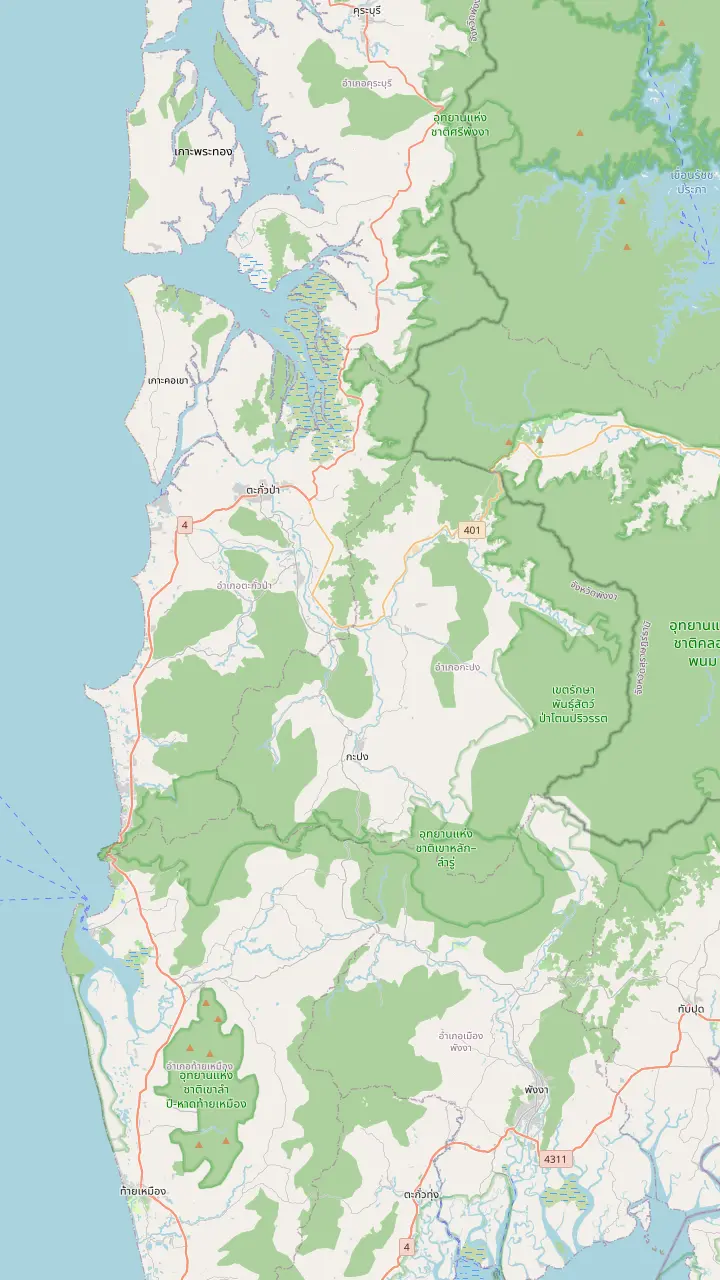
Nang Thong is among the most popular beaches of the Khao Lak strip.
Google MapsThe national park behind Khao Lak, where the trails and falls start.
Google MapsA waterfall inside the Khao Lak-Lam Ru park area.
Google MapsA fall in the hills behind Khuk Khak.
Google MapsLampi waterfall lies south of Khao Lak, in the Lampi park area.
Google MapsKhao Sok National Park, inland and east of the coast, reached by day trips from Khao Lak.
Google Maps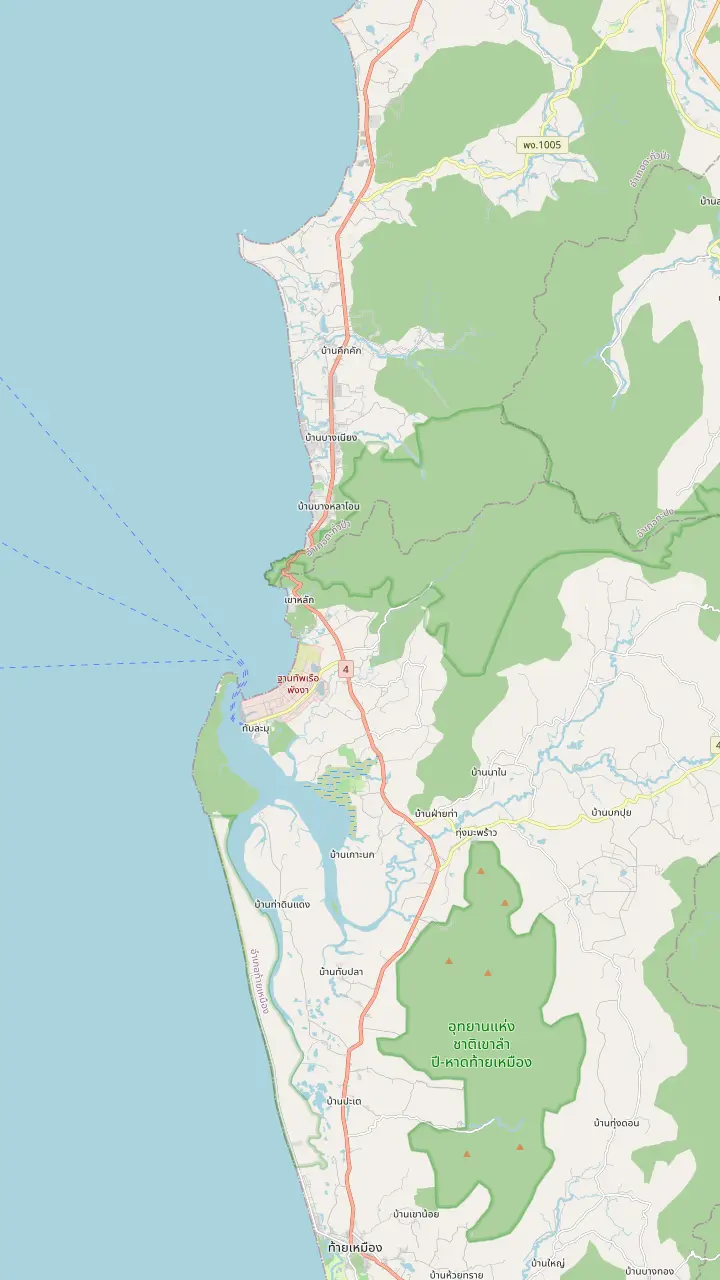
The sea turtle conservation center at Tap Lamu, the last stop of the home tour day.
Google MapsThe natural harbour at Thap Lamu is the departure point for most Similan day trips and liveaboards.
Google MapsA national park south of Khao Lak that protects nesting beaches.
Google MapsPakarang Beach and its cape are the centre of the local surf scene.
Google MapsNang Thong is among the most popular beaches of the Khao Lak strip.
Google MapsBase map © OpenStreetMap contributors
Khao Lak's temple days centre on a cave temple with monkeys and a reclining Buddha. Here is what the temples are, how the tours link them, how to dress and behave, and the memorials nearby.
Editorial team, khaolakrafting.com · Updated November 12, 2026 · 7 min of reading
Essentials
The monkey temple of Khao Lak is Wat Suwannakhuha, also written Suwan Khuha, a cave temple in Phang Nga province. The Thai government's Phang-nga guide calls it one of the province's important temples because of its history and archaeology, set on a mountain with a number of caves.4 It lies about 9 kilometres from Phang-nga provincial town, so plan for a drive from the coast rather than a nearby stroll.5
The largest cave is Tham Yai, on the lowest level, decorated with ceramic tiles and crockery along its length. It serves as a wihan with several Buddha images, and the most important is the Reclining Buddha.1 A listing for the day tour calls it the Suwan Khuha Cave Temple and mentions its golden reclining Buddha. In another cave, the guide notes initials left by kings and royal family members.6
The monkeys are why many people search for the monkey temple in Khao Lak. According to the guide, the space before the cave is where a large number of monkeys come to feed.2 The same guide lists an admission of 10 baht, though it is an older printed figure, so check the current price at the gate.7 Treat the visit as a visit to a place of worship that happens to have wildlife, and not the other way round.
The temples
| Place | What it is | Reached by | Note |
|---|---|---|---|
| Wat Suwannakhuha | Cave temple with monkeys4 | The temple tour | Reclining Buddha1 |
| Wat Bang Riang | Chedi on Khao Lan14 | Guide entry13 | Naga Buddha image15 |
| Wat Narayanikaram | Hindu images and an inscription16 | Independent visit16 | Ties to Takola16 |
| Ban Nam Khem park | Tsunami memorial3 | Own transport | Wall of names3 |
Entries from the Thai government's Phang-nga guide and the listing for the temple day; confirm access and any fee locally.4
The tour to book if you want several temples at once is the 9 hour full-day temple tour from Khao Lak. It visits the caves at the Dragon Cave temple in Khao Lak, takes in views from the Bang Rieng Temple, visits the Suwan Khuha Cave Temple and breaks for a Thai lunch. That covers the temples in the literal sense, and the listing asks guests to be in the hotel lobby 15 minutes before the pickup.
The listing gives no detail on the Dragon Cave Temple beyond its caves, so use the guide for the wider region. The guide's Wat Bang Riang, also called Wat Rat Uppatham, stands on Khao Lan in Ban Bang Riang, about 11 kilometres from the Thap Put district office.13 It has a bell-shaped chedi ringed with niches for Buddha images, and images of Kwan Yin and a Buddha seated under the Naga hood, cast to protect people of the south from natural disasters.14,15
The guide does not link the tour's Dragon Cave Temple to any of its entries, so do not assume which temple that is: ask the operator what the stops are called before you go. The tour is long, which is why it suits travelers who want temples to be the main subject, not a short add-on to a rafting morning, and why a lighter day on either side of it helps, since the tour is long.
Length of the day
Hours as the listings state them: the Takua Pa tour 4, the Sok River and cave temple tour 4.5, the elephant, raft and temple day 7 and the full temple tour 9.
North of Khao Lak, a 4 hour tour strings together the Takua Pa food market, a new Tsunami Museum, the Kong Ka Temple with its pagoda and the old town. It is a gentler alternative for people who find a very long day too much, and it keeps the temple in a 4 hour slot. The listing states that knees and shoulders should be covered and that shoes, hat and sunglasses come off in temples and places of worship.
Several rafting days include a temple stop. A 7 hour small group tour spends 30 minutes at the Phanthurat Temple between the elephant centre and lunch, before rafting the Sok River. A 4 to 4.5 hour Sok River tour pairs bamboo rafting with a cave temple with monkeys and the Khao Sok View Point. A 9 hour adventure day adds the Wat Tham Suwan Khuha stop to an ATV, a zipline and rafting.
For history, the government guide mentions Wat Narayanikaram in Kapong district, where replicas of Narayana and Lakshamana are enshrined with the original Sida image. An inscription stone of 1,300 to 1,400 years old was found on Khao Riang in the temple grounds.16 The guide ties these finds to Takola, the old name of Takua Pa, and to the introduction of Indian culture to the region. No tour on this page lists it, so it suits independent travelers. The same listing works as a 3 temple tour from Khao Lak for travelers who prefer one long day to several short ones.
Your kind of day
Say how long you want to stay in temples and a tour appears.
If I want several temples
The full temple day
9 hours with lunch, from $72.
If I want something shorter
The Takua Pa tour
4 hours with a museum, from $52.
If I want temples and a raft
The Sok River tour
A cave temple with monkeys, from $54.
If I want action too
The ATV and rafting day
Adds a temple stop, from $86.
If I want the monkeys
Wat Suwannakhuha
The cave temple with a monkey feeding ground.2
Temple days
Most temples
Caves, views, reclining Buddha
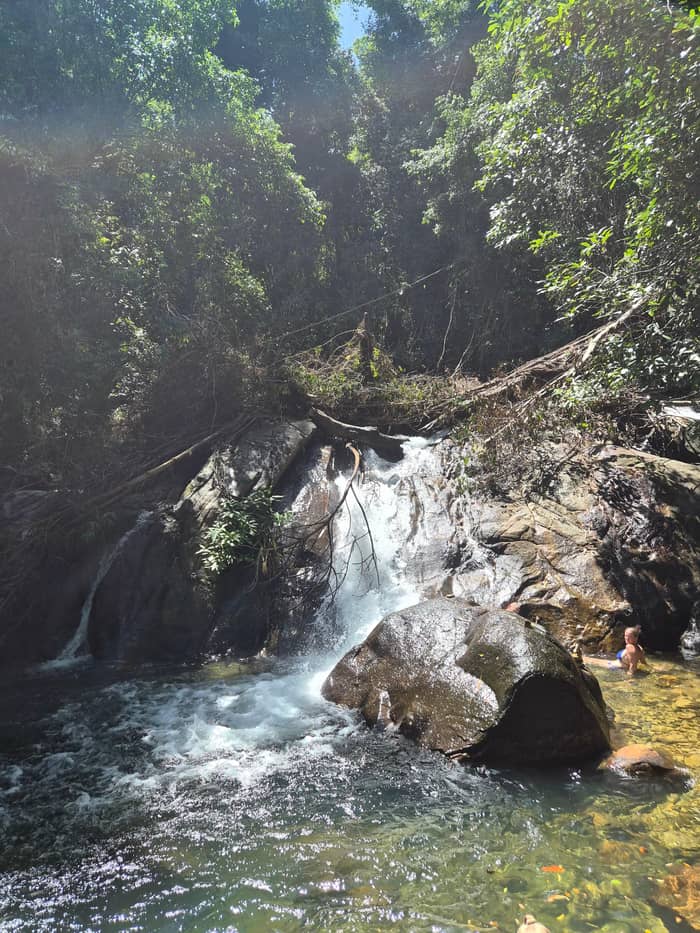
Shortest
Market, museum, temple
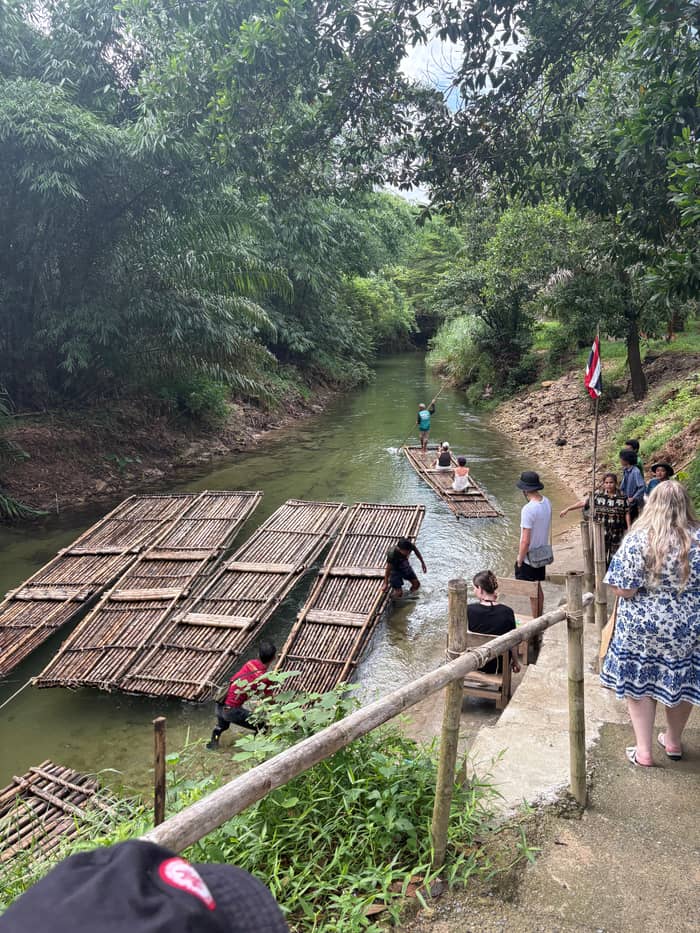
River mix
Raft and monkeys
Thailand's tourism authority says temples command deep respect among Thai people, and visitors are welcome as long as they follow the expected etiquette.17 The dress rule differs by gender: men need a sleeved shirt and trousers or knee-length shorts, women a sleeved top and a skirt that reaches below the knee.8 Pack a light shirt and a wrap for the day, even if you start it in beachwear.
Take your shoes off at the door. TAT says you go in barefoot and leave your shoes on the racks outside.9 Stepping over the raised threshold, and not on it, is part of the code.10 Sit with your feet pointing away from a Buddha statue, never toward it, and do not touch or point at the statue, walking around sacred objects clockwise.11,12 Hats and sunglasses come off, phones go silent, voices stay low, and there is no smoking, gum or snacking while you walk around.24
A woman must not touch a monk or his robes, so anything meant for a monk is put down for him to pick up.26 Photographs are usually allowed, but stepping in front of worshippers who pray or donate is discourteous.27 In a cave temple, remember that the space is both small and sacred: wait for people to finish a prayer before you step in front of a shrine, and keep the group moving.
Price your day
Give your group size and each fare is multiplied for you.
Side-by-side: 4 options
Give your group size and each fare is multiplied for you.
≈
View≈
View≈
View≈
ViewGetYourGuide's starting prices, converted at the ECB reference rate; exact pricing appears when you book.
At the temple
Arrive
Cover shoulders and knees before you enter.8
Door
Leave your shoes on the racks outside.9
Threshold
Step over the raised threshold and not on it.10
Sitting
Point your feet away from the Buddha statue.11
Leaving
Never turn your back on the statue; walk around sacred objects clockwise.12
A cave temple with monkeys invites you to hand out food, and the guide itself describes the space before the cave as where the monkeys feed.2 That does not mean visitors should feed them. TAT's guidance on encounters with wildlife lists refraining from feeding wildlife and avoiding close interactions among its basic rules.25 The advice was written for elephants, but it applies to any wild animal.
Keep food and plastic bags out of sight, put your phone away while you walk past, and do not reach toward a monkey. If one approaches, step away calmly instead of shouting or running. Temple staff and guides know the habits of these animals better than a visitor can, so follow their lead, and keep your distance even when an animal looks tame.
Be careful with children near the cave, and hold small hands. Keep sunglasses and loose items inside a zipped bag. The visit is better if you bring nothing edible at all and enjoy the sculptures, the tiles and the cool air of the cave. Nothing here replaces a guide's instructions, which should always come first, and a short pause outside the cave to let a group pass keeps the path clear for everyone.
Video
IRATRAVEL VODYANITSKAYA on YouTube · The video only starts loading on your tap.
They are held in the highest respect by the Thai people and while tourists are openly welcome, there is a certain etiquette that is expected
The Khao Lak coast has memorials that deserve a quiet visit. At Ban Nam Khem, north of Khao Lak, a memorial park has a leaning brick wall with the names of the dead on bronze plaques, and the guide mentions approximately 1,400 casualties.3 A separate memorial, Police Boat 813 at Ban Bang Niang, is a 60-ton boat that the tsunami carried inland to the foothill.28,29
A tour that includes a Tsunami Museum is the 4 hour Takua Pa tour from $52. The full-day temple tour is from $72, and the combined rafting-and-temple adventure day from $86. The Sok River bamboo tour with a cave temple costs from $54. Choose according to how long you want to stay in temples.
At a memorial, dress as you would for a temple, speak quietly, and do not treat it as a photo stop. If you are with children, explain beforehand where you are going and why people go quiet there. The memorials exist as places of remembrance, so give them the time and the silence a visit deserves, and leave the camera in the bag if the moment calls for it.
FAQ
The full-day listing names the caves at the Dragon Cave Temple among three temples.
The listing runs 9 hours with a Thai lunch.
TAT and a listing both ask for covered knees and shoulders.8
Visitors go in barefoot, leaving shoes outside.9
TAT's wildlife guidance lists refraining from feeding wildlife.25
That figure is from an older printed guide, so confirm at the gate.7
A market, a museum about the tsunami, a temple and the old town fit into 4 hours.
Sources
Continue reading
Planning a river day near Khao Lak? Ask a real person here.